@rubrion/mastra-cloudflare 0.2: Mastra agents on Workers, from npm
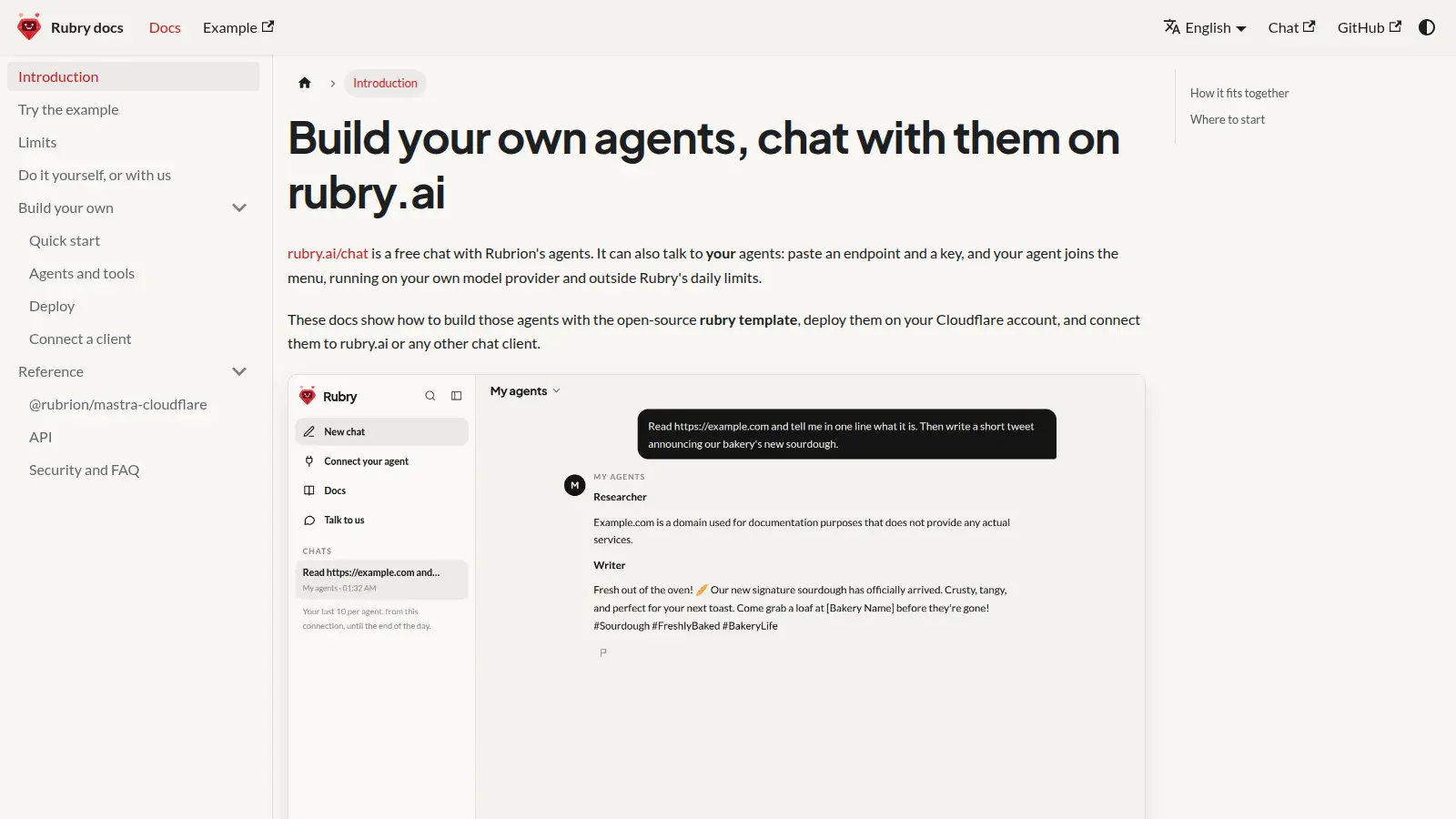
What began as a starter in June is now a library: an OpenAI-compatible agent server, D1 memory and model helpers, in one npm package.
Most agent stacks assume a server running all day, and every project ends up rewriting the same glue: an API, routing between agents, memory. @rubrion/mastra-cloudflare is that glue, for Mastra agents on Cloudflare Workers.
From starter to library
- June 13: the repository started as a starter: a Mastra agent on Workers with D1, to copy and edit.
- October 20: every project we built on it copied the same files, so we turned it into a library: 0.1.0, published on npm. The rubry template and rubry.ai run on it.
- October 29: 0.2.0, with per-environment limits and token usage in every reply.
- October 30: 0.2.1, extra headers on remote models, so a platform can pass who's asking to an agent that runs elsewhere. That's how Equânime keeps each person's analyses apart on rubry.ai.
What's in the package
createAgentServer: an OpenAI-compatible server (/v1/models,/v1/chat/completionswith real SSE streaming) as a Workerfetchhandler, with no HTTP framework.model: "auto"routes each message to the right agent, or splits it across several.defineAgents: agents as plain config, built lazily once per isolate, because bindings and secrets can only be read inside a request.d1Memory: Mastra Memory on D1, with no vector store to pay for.workersAI,openAICompatible,providerModel: models from Workers AI, any OpenAI-compatible endpoint, or the provider each request carries.- Re-exports
Agent,createTool,zandRequestContext, so a project needs only this package.
A Worker in 20 lines
npm install @rubrion/mastra-cloudflare
import { env } from 'cloudflare:workers';
import { createAgentServer, createTool, d1Memory, defineAgents, z } from '@rubrion/mastra-cloudflare';

const time = createTool({
	id: 'current_time',
	description: 'The current date and time.',
	inputSchema: z.object({}),
	execute: async () => ({ now: new Date().toISOString() }),
});

const agents = defineAgents(
	[
		{ id: 'writer', name: 'Writer', description: 'Writes and edits text.', instructions: 'Write what is asked, briefly.' },
		{ id: 'helper', name: 'Helper', description: 'General questions; knows the time.', instructions: 'Be useful.', tools: { current_time: time } },
	],
	{ memory: d1Memory(() => env.MEMORY) },
);

export default createAgentServer({
	agents,
	apiKey: (e: Env) => e.API_KEY,
	provider: (e: Env) => ({ baseURL: 'https://api.openai.com/v1', apiKey: e.OPENAI_API_KEY, model: 'gpt-5-mini' }),
});
New in 0.2
maxAgents(how many agentsautomay split a request across, default 3) andmaxSteps(tool rounds per reply, default 5) take a number or(env) => number, so a public demo can be stricter than production without a second build.- Token usage in every reply: OpenAI's
usagefield, summed over the planner, every agent and every tool round, in the JSON body or on the final streamed chunk. rubry.ai's daily budget is computed from it.
Links
- npm: @rubrion/mastra-cloudflare
- Source (GPL-3.0): github.com/rubrion/mastra-cloudflare
- Reference: docs.rubry.ai/library
- Built on it: github.com/rubrion/rubry · github.com/rubrion/agent-kit
- Case study: Mastra on Cloudflare
Building agents on Cloudflare and want a hand? Let's talk.